Basements, Castle Keeps, Prisons, Secure Mental Institutions, Hospitals, Clubs, Mansions, Oil Rigs and even on Cruise Ships – (some famous clients too).
We’ve put tables in through roofs with cranes, across planks, with JCBs, in lifts, up and down multiple staircases including spiral ones, on ropes and hoists, via winches – the list goes on.
We have even installed a glass table and a table made entirely out of slate weighing 3.5 tons!
Some of the most challenging jobs have turned out to be the most satisfying.
We recommend using a professional service to move English Pool tables usually around 7ft in length, not only do they weigh around 300kg but the slate beds are easily broken.
When it comes to full size Snooker tables or American Pool tables you should definitely use professionals. A full size snooker table can weigh up to 1.7 tons. The slate bed is also sectional so requires care in moving and expert installation.
We have moved thousands of tables, upstairs, downstairs, through roofs, windows, cellars, spiral staircases and many tight spots!
You name it, we have probably done it! We have the labour and equipment to do it safely. Don’t risk serious injury, even death – we are aware of at least one person being killed attempting to move a table just a few feet. Sectional tables are not meant to be moved in one piece.
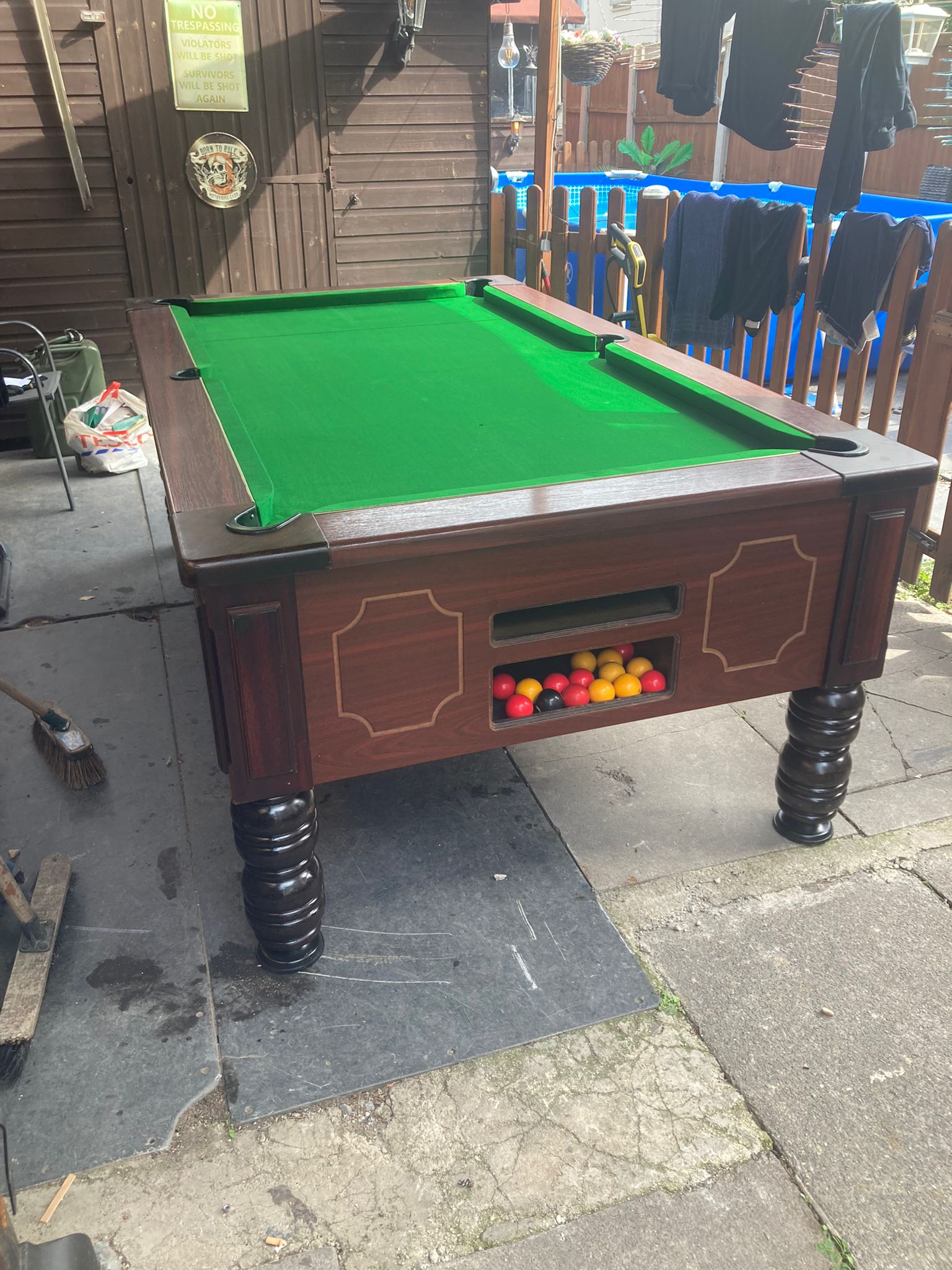
NEW – FOR SALE – Superleague traditional table, 7ft x 4ft, coin operated, currently set on 50p – can be altered or set on freeplay. New cloth fitted, very good condition. One of the best tables out there. Complete with balls, cues, triangle etc. £1200.
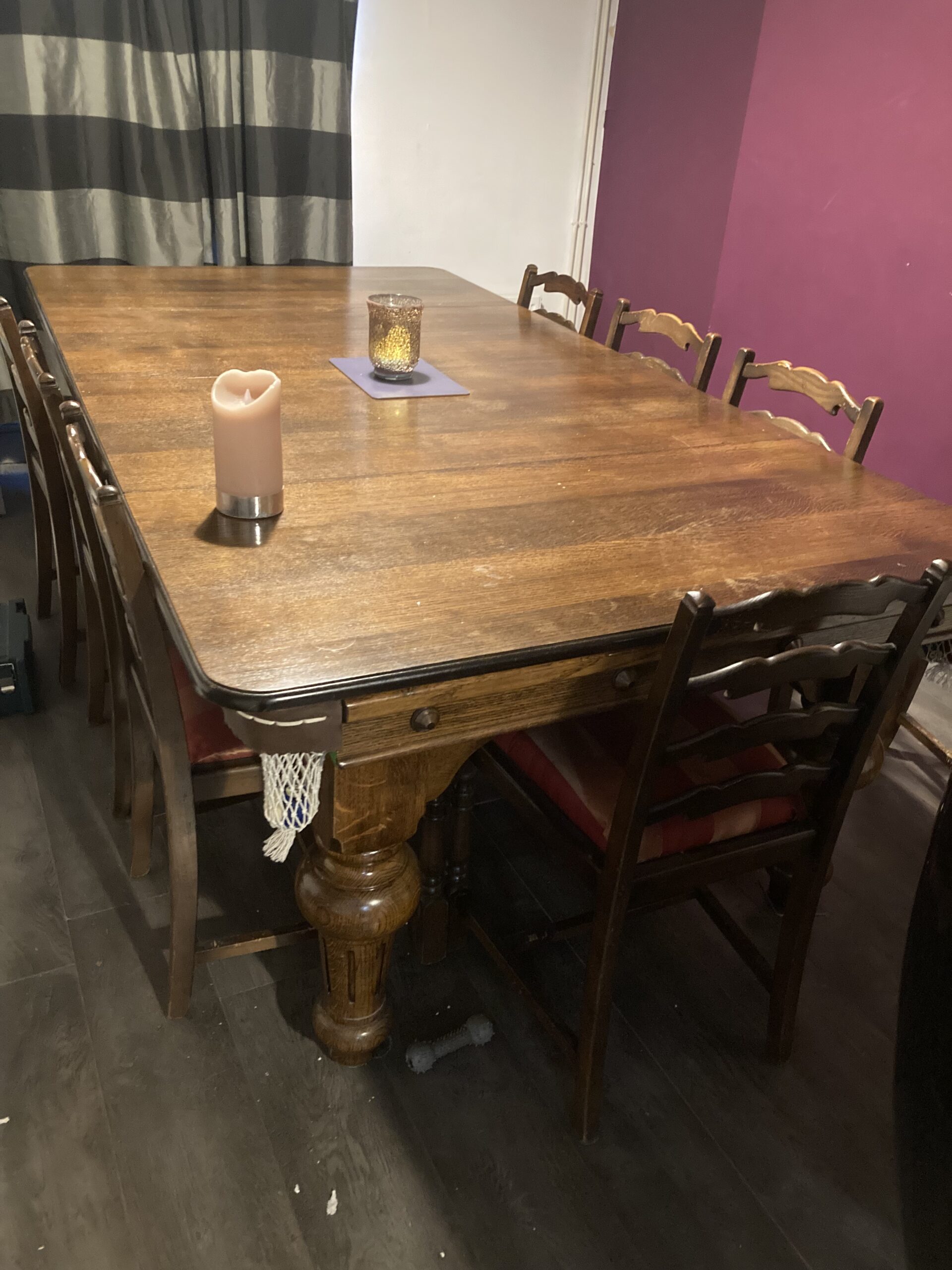
NEW – FOR SALE – Oak snooker diner, 7ft x 3.6ft dual height table, 8 chairs (2 of which are Carvers), revolving matching Oak cue rack, matching scoreboard and set of pool balls. £3000.
There are a number of snooker/dining tables which, as the name implies, have a dual purpose. Now it may seem just a case of adding a dining top to a snooker table right?
Not quite that simple as most snooker tables have deep side rails (you can’t get chairs underneath them!) and in any case dining height is some 4/5 inches lower. So manufacturer’s like Riley’s came with up with a clever dual height adjustment system.
One of these simple but ingenious brass and steel slides placed at each corner, simply lifting the table up locking it off at the higher height, lifting again lowers the table back to dining height. Narrow frame rails mean chairs fit underneath with clearance for peoples legs. These tables go from 5ft, 6ft, 7ft, 8ft – 8ft being the largest stock table, capable of allowing dining for 8/10 people.
6ft x 3ft Riley Snooker Diner
There are a rare number of 9ft snooker diners out there but the problem with these is they are sectional slate beds as 8ftx4ft is the largest available single piece of slate, so are very heavy and difficult to lift into position, requiring constant leveling.
There are other rare wind up tables and roll-over tables where the entire centre section spins over, however these are not a particular favourite of mine as it’s possible to trap a hand or finger in them, also the added extra width of the external frame can hinder play.
Most people know about snooker and pool tables but there are many others out there such as circular tables some which revolve, “L” shape tables, bar billiard tables, baggatele tables, 3 cushion or canon tables with no pockets – scoring is by canons only.
A full size snooker table is 12ft by 6ft but there are a few larger tables out there built in the early 1800s, often just to show off or to fill a large room – tables up to 15ft in length are not unknown!
I have personally come across a 14ft x 6ft 6inch table, which created a problem as the cloth is made to fit 6ft wide tables. By the time we had finished it was probably the tightest cloth in the country! Even now after over 40 years in the trade we come across tables we have never seen before, sometimes from makers we have also never heard of. In the early days tables were often commissioned by wealthy clients using furniture companies, not just billiard table makers, so there are a lot of one-offs out there. Often a furniture company would be commissioned to build the whole billiard room including all paneling, furniture and fixtures and fittings.
There are basically two types of cloth fitted to snooker and pool tables. Either napped or directional cloth (like dralon – smooth one way with resistance the other way) or nappless cloth often referred to as “speed cloth”. Snooker tables are normally fitted with a napped cloth whereas pool tables can be fitted with either napped or nappless cloth.
Napped cloths allow more control of the cue ball due to the extra grip, whereas nappless cloths are faster but offer less cue ball control.
American pool tables are usually covered with speed cloth. Napped cloths are available in several different grades for heavy duty use, through to superfine finish competition grades. There are not nearly so many grades in speed cloths.
Most people know the bed of a snooker table is made of slate, with the frames and cushions being constructed of timber. However in the mid 1800s a firm by the name of E.G. Magnus made quite a few tables with slate being used for the frame and cushions!! Many were shipped to tropical countries due to termite and beetle attacks on the timber. Wooden frame tables often had plates of paraffin placed underneath them which due to the smell was hardly an ideal solution.
There are some very notable tables both in Queen Victoria’s Osborne House on the Isle of Wight and Penrhyn Castle, Bangor, North Wales – though this particular table has a mystery surrounding the actual maker. These tables have enamel paint and inlays applied to the rather dull slate surface to enhance their appearance.
I have only ever come across one of these tables in the UK which we had to move to a new site. Weighing in at over 3.5 tons (normal tables weigh around 1.5 tons) it was a very difficult, long job, bearing in mind slate doesn’t bounce well! Drop one of the legs or frame parts and it’s game over as slate just shatters into thousands of little pieces. There are a few parts of slate framed tables made of timber such as the cushion cappings but even the internal bearers on this particular table were made of slate. Rare beasts indeed.
I am sure we have all seen shots on the televised competition tables that would never have gone in on our club tables?
Well firstly you are seeing shots from angles on TV that you don’t normally see – the recent innovation of slow motion also adds to the confusion.
There is no doubt championship pockets have been getting more generous in the last few years – an admission of this is the tightening of the middle pockets in this year’s 2019 World Snooker Championship, though the corners remain easy compared to many much older club tables.
There were over 100 centuries in this years tournament, beating the previous record of 86 which is quite telling. Certainly the large number of competitive competitions has raised the players standard but the pockets do play a part. Ultimately, it’s down to television and the sponsors, big breaks make good TV and easier pockets bring lesser known players into the game giving them a chance against the better players.
That’s in no way to decry the ability of the top players – if pockets were 3 times the size on my local club table and I practiced 8 hours every day I would never get anywhere the standard of the top 100 players, I know, I’ve tried!
As a final note there is talk of tightening the pockets up a bit more next year, we shall have to wait and see!
You’ve probably noticed that even in a snooker hall with several seemingly identical tables, they all tend to play slightly differently?
The answer is in the materials used to construct a snooker table. Almost every part is made from natural materials, the frame and side rails are wood, the bed is slate, cushions are rubber, cloth is wool, pocket nets are cotton, pocket plates are covered in leather. All these natural substances vary slightly.
The most significant factor is the cloth made from sheep’s wool. Now to you and I all sheep might look alike, but they are not. They are individuals just like us – hence the quality of the wool varies season by season, certain weather conditions make the wool much finer, which makes for a better quality cloth. We usually try to select a roll of cloth with a finer finish if possible but even then it can vary over the individual roll. Even the championship tables with their heaters, air conditioning etc. don’t provide the same conditions every time.
The cloths in major tournaments are often changed after every round or even every session, and players will take time to adjust to different speeds and rolls of the cloth.